
All products

MS719 · Electromechanical Vibrations
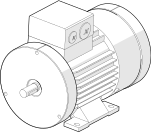
Electromechanical vibrations experiment — interaction of electromagnetic and mechanical systems in an asynchronous motor

Experiments
  • Influence of the stator–rotor gap on vibration behaviour — adjustable asymmetry up to 0.2 mm
  • Influence of electromagnetic asymmetry (winding that can be switched off) on vibration behaviour
  • Influence of mechanical load on the vibration level (with MS705)
  • Influence of the gap on electromagnetic losses and motor efficiency
  • Influence of speed on the vibration behaviour of the motor
  • Measurement of current consumption per phase (with a current probe — not included)
  • Interpretation of frequency spectra — separating rotational (n, 2n) from electromagnetic (2fe, 4fe) contributions
  • Works together with the MS700 base unit
MS719
Description
    Asynchronous motors are the most common drive in industry, and their vibration spectrum mixes purely mechanical contributions with those originating from the magnetic field. The MS719 experiment isolates these effects: an adjustable centring device introduces a controlled asymmetry in the stator–rotor gap, while a switchable winding introduces electromagnetic asymmetry. Loaded via the MS705 brake, the motor reveals how each imperfection maps to its own lines in the spectrum.
MS719 electromechanical vibrations experiment — schematic
Specifications
    Motor asynchronous, variable speed via frequency converter of MS700
    Speed range 100…6000 min⁻¹
    Nominal power output 370 W
    Gap asymmetry adjustable armature eccentricity 0…0.2 mm with graduated scale
    Electromagnetic asymmetry winding that can be switched off
    Loading requires MS705 brake & load unit
    Instrumentation speed and power displayed on MS700 control unit; current probe optional
    Storage 400 × 300 × 320 mm stackable case with foam inlay
    Weight approx. 11 kg

Part of package

Machinery Diagnostics Lab

A modular training system for vibration measurement and condition monitoring of rotating machinery. Built around the MS700 base bench, it covers rotor dynamics, coupling and bearing faults, belt drives, gears, cavitation, fan and motor vibration through interchangeable experiments.

Request a quote for the full lab