All products

MS714 · Belt Drive Experiment
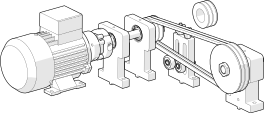
Belt drive experiment — vibrations, resonance and slip in V-belt transmissions

Experiments
  • Influence of belt tension on the vibration behaviour of the drive
  • Influence of speed and load on the vibration spectrum
  • Effects of pulleys running untrue, off-track running and eccentric pulleys
  • Power split across a multiple-belt drive with individually adjustable tensioners
  • Influence of slip on the vibration running spectrum
  • Comparison between fault-free and damaged V-belts
  • Application of transverse loads to other MS700-series experiments — e.g. MS711 and MS712
  • Works together with the MS700 base unit and the MS705 brake & load unit
MS714
Description
    A well-designed belt drive is silent, efficient and long-lived — provided the belt does not slip or vibrate. The MS714 dual V-belt drive lets students deliberately provoke both. Individually adjustable tensioning rollers, an eccentrically-bored pulley and a deliberately damaged V-belt cover the main fault classes; the experiment can also serve as a transverse-load source for other MS700-series experiments.
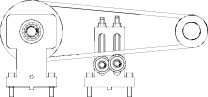
MS714 belt drive experiment — schematic
Overview
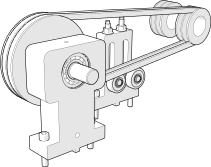
    MS714 front view
Specifications
    Pulleys large Ø 125 mm; small Ø 63 mm; small eccentric Ø 63 mm
    Axle centres 300 mm
    V-belt SPZ, approx. 10 mm wide, length 912 mm
    Included 3 V-belts (incl. damaged), 3 pulleys, tensioning roller set, belt pre-tension gauge 0…150 N
    Load pairs with MS705 for controlled braking torque
    Compatibility designed for the MS700 base unit
    Storage 600 × 400 × 170 mm stackable case with foam inlay
    Weight approx. 6 kg

Part of package

Machinery Diagnostics Lab

A modular training system for vibration measurement and condition monitoring of rotating machinery. Built around the MS700 base bench, it covers rotor dynamics, coupling and bearing faults, belt drives, gears, cavitation, fan and motor vibration through interchangeable experiments.

Request a quote for the full lab