
All products

MS717 · Cavitation in Pumps
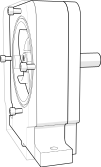
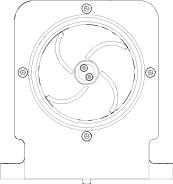
Cavitation in pumps experiment — visual and vibration study of cavitation in a centrifugal pump

Experiments
  • Experimentally inducing cavitation in a centrifugal pump by throttling the intake
  • Visual observation of cavitation bubbles through the transparent pump housing
  • Stroboscopic analysis of cavitation (stroboscope sold separately)
  • Identification of cavitation in the vibration spectrum
  • Investigation of the normal operational vibrations of a centrifugal pump
  • Pump driven directly (via coupling on MS700) or via the MS714 belt drive
  • Interpretation of frequency spectra and use of the Sangari vibration analysis software
MS717
Description
    Cavitation is one of the dominant sources of vibration in centrifugal pumps. The MS717 experiment makes the phenomenon visible and measurable on the laboratory bench: a single-stage centrifugal pump with a transparent housing draws water from a 20 L tank, and valves plus manometers on the intake and delivery lines let the student set any operating point — including those at which cavitation bubbles appear inside the impeller.
MS717 cavitation in pumps experiment — schematic
Overview
    MS717 front view
Specifications
    Pump type single-stage centrifugal, transparent housing
    Max flow rate 17 L/min at 3300 min⁻¹
    Max head 12 m at 3300 min⁻¹
    Impeller 3 blades
    Cavitation onset approx. 2240 min⁻¹ with intake throttled
    Tank HDPE, 20 L capacity
    Manometers delivery 0…4 bar; intake −1…1.5 bar
    Drive direct coupling to MS700 or via MS714
    Storage 600 × 400 × 320 mm stackable case with rubber mat
    Weight approx. 16 kg

Part of package

Machinery Diagnostics Lab

A modular training system for vibration measurement and condition monitoring of rotating machinery. Built around the MS700 base bench, it covers rotor dynamics, coupling and bearing faults, belt drives, gears, cavitation, fan and motor vibration through interchangeable experiments.

Request a quote for the full lab