
All products

MS711 · Crack Detection in Rotating Shaft
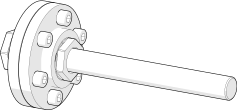
Crack detection in a rotating shaft — experiment for vibration-based damage identification

Experiments
  • Change in vibration characteristics (natural frequency, resonance speed, amplitude, phase) caused by a radial crack
  • Crack identification from the vibration spectrum — focus on the 2nd-order component
  • Detection of cracks in the protruding end of a rotating shaft (with belt drive load from MS714)
  • Detection of cracks in an elastic rotor (with safety bearing from MS710)
  • Four crack severities reproduced by varying the number of load-bearing bolts on the flange joint
  • Interpretation of frequency spectra and use of the Sangari vibration analysis software
  • Works together with the MS700 base unit
MS711
Description
    A crack in a rotating shaft changes its stiffness and therefore its vibration fingerprint. The MS711 experiment simulates this realistically through an asymmetric flange joint: by progressively removing load-bearing bolts, a "gap" that mimics a crack of increasing depth appears during each revolution. The same experiment supports two scenarios — a protruding shaft end loaded by the belt drive, and an elastic rotor running close to its critical speed.
MS711 crack detection experiment — schematic
Overview
    MS711 front view
Specifications
    Flange Ø 90 mm, 6 × M8 × 20 hex bolts → 4 selectable crack sizes
    Shafts Ø 20 mm; short L = 85 mm, long L = 200 mm
    Max bending torque short shaft (belt pulley) 15.9 Nm; long shaft (mass disk) 3.9 Nm
    Included pick-up disk, centring arbor, 6 bolts, clamp set, tool set
    Compatibility designed for the MS700 base unit; pairs with MS714 and MS710
    Storage 400 × 300 × 120 mm stackable case with foam inlay
    Weight approx. 3 kg

Part of package

Machinery Diagnostics Lab

A modular training system for vibration measurement and condition monitoring of rotating machinery. Built around the MS700 base bench, it covers rotor dynamics, coupling and bearing faults, belt drives, gears, cavitation, fan and motor vibration through interchangeable experiments.

Request a quote for the full lab