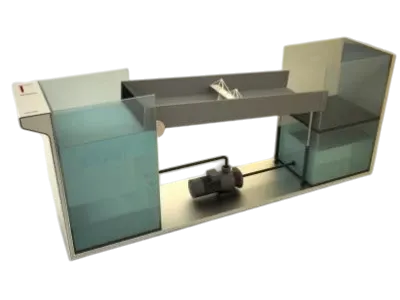
Experimental Apparatus for Free and Forced Vortices
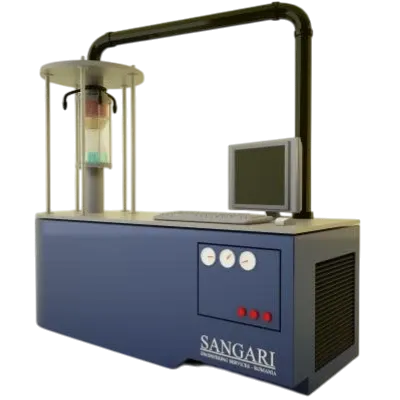
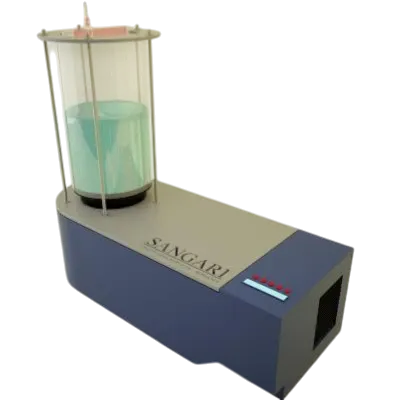
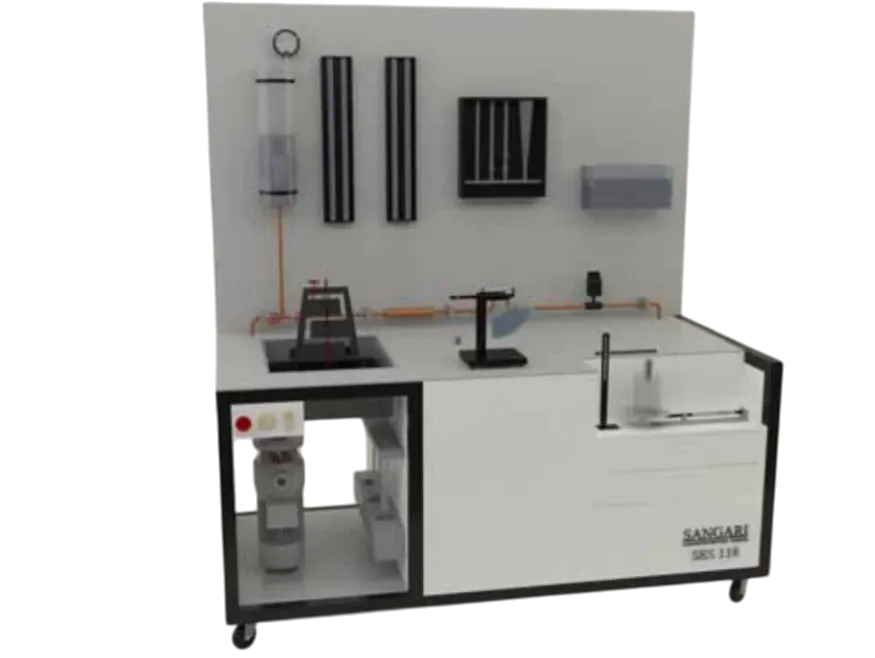
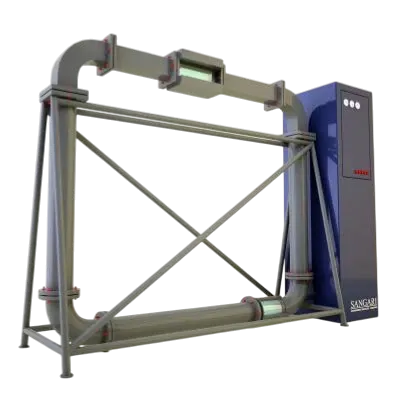
The apparatus comprises a reservoir, a supply pump, a hydraulic circuit, and a test section. The generation and visualisation of the central vortex, as well as the measurement of its associated
quantities, are carried out in the test section.
Experiments
The central vortex and its precession motion can be observed with the naked eye.
Analogue sensing allows the observation of unsteady pressure variations (via an indicator needle oscillating relative to a reference point).
Digital recording enables the acquisition of unsteady pressure signals and the computation of Fourier transforms for the determination of amplitude and frequency.
Description
Theoretical principle demonstrated: Generation of a helical hydrodynamic instability when the swirl number exceeds its critical value.
Operating principle: Certain swirling flows lead to the loss of stability and the formation of a central vortex. The mechanism of stability breakdown in swirling flows is as follows:
a vorticity sheet is generated by the shear layer developing between the central stagnation zone and the surrounding fluid stream; this sheet loses stability and degenerates into the central
vortex.
Observations with the naked eye: Air admitted into the vortex formation region renders the vortex structure visible, allowing observation of the precession motion of the central
vortex as well as the formation and breakdown of its tail.
Instrumentation: Flow meter for water flow rate measurement; unsteady pressure transducers for the measurement of pressure fluctuations generated by the central vortex.
Specifications
Variable-speed pump to generate a range of flow rates