
All products

TH541 · Steady-state & transient heat conduction
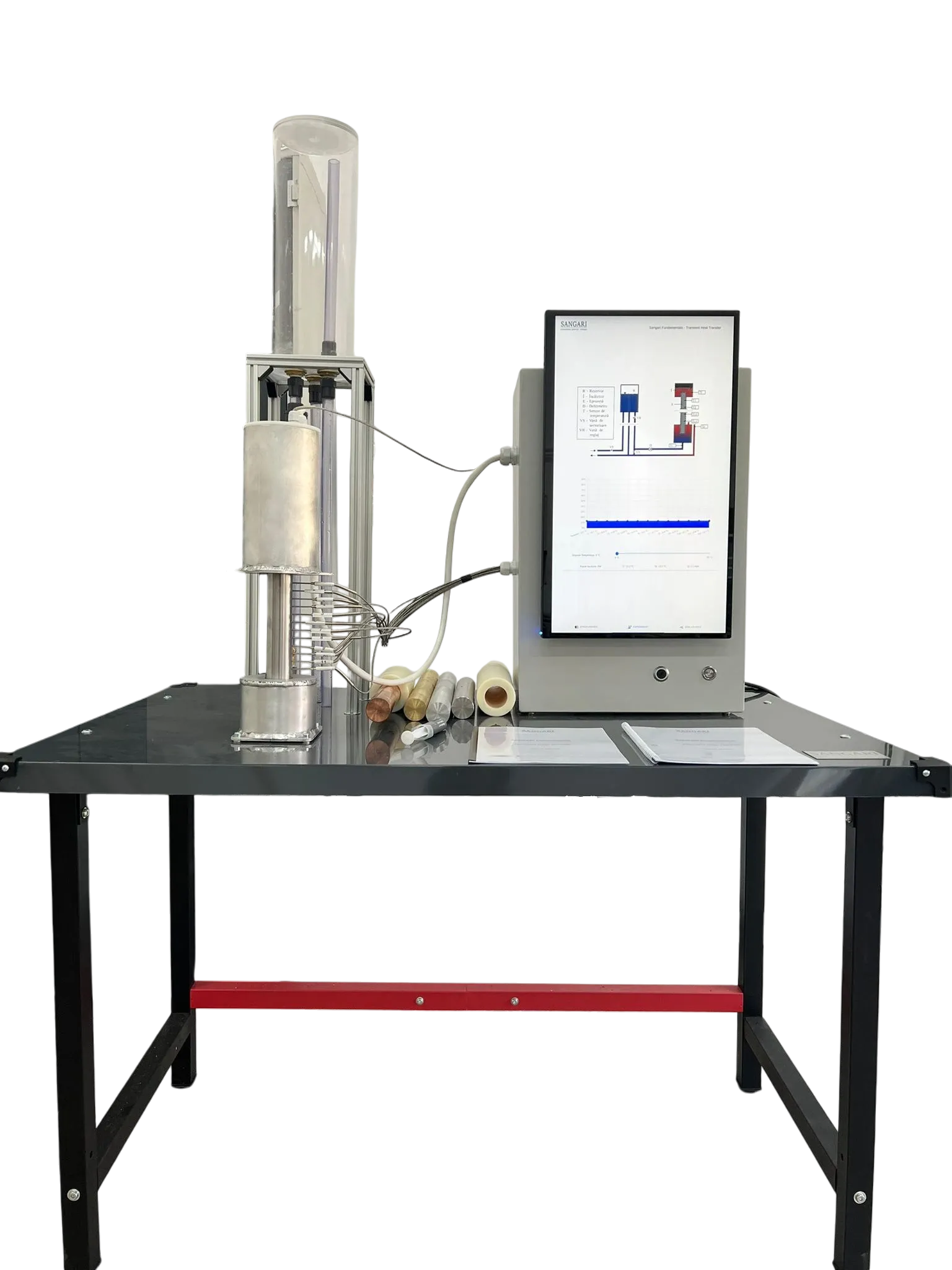
Experimental bench for the study of steady-state and transient heat conduction in metals

Key features
  • Simultaneous study of steady-state and transient heat conduction in a single bench
  • Five interchangeable specimens — copper, aluminium, brass, steel, stainless steel — in two lengths
  • Twelve type-K thermocouples per specimen for high-resolution spatial temperature mapping
  • PID-controlled hot-water heat source (20-85 °C, 800 W) ensures stable, repeatable boundary conditions
  • Elevated overflow tank guarantees constant cooling-water flow rate for reproducible transient experiments
  • All measurements — temperatures, heating power, flow rate — displayed digitally and logged Online
  • Software included for data acquisition, plotting, and thermal conductivity calculation
TH541 — Steady-state and transient heat conduction bench
Overview

    The TH451 is built around this distinction. A precisely regulated hot-water circuit heats one end of a cylindrical metal rod; a water-cooled heat sink conditions the other. Twelve thermocouples embedded along each rod — designed to minimise thermal disturbance and measure true core temperature — capture the full spatial distribution of temperature under both equilibrium and dynamic conditions. A sudden change in cooling-water flow rate generates a clean thermal step that propagates through the specimen, making transient conduction directly visible and measurable. Five interchangeable rods in different metals and two lengths complete a systematic experimental programme that carries students from Fourier's law through to the numerical methods used in industrial thermal simulation.

Laboratory experiments

    The following experiments form a coherent progression from classical steady-state theory through to the time-dependent partial differential equations that underpin modern computational heat transfer.

  • Verification of Fourier's law — steady-state heat conduction.
  • Material comparison — ranking metals by thermal conductivity.
  • Effect of specimen length on the steady-state temperature profile.
  • Transient heat conduction — observing the propagation of a thermal step.
  • Temperature-time profiles and thermal diffusivity.
  • Validation against analytical solutions.
Specimens
    Geometry Ø 40 mm, 12 embedded type-K thermocouples per rod
    Long (450 mm) copper, aluminium, brass
    Short (300 mm) steel, stainless steel
Heat source
    Heater output 800 W
    Water temperature 20 … 85 °C
    Control PID controller
    Heating tank ~2 L
Heat sink
    Type Water-cooled
    Elevated tank ~6 L (constant flow)
    Cooling tank ~0.5 L
Temperature sensors
    Along specimen 12× thermocouple type K
    Cooling water 2× Pt100
    Heating water 1× Pt100
Measuring ranges
    Temperature 0 … 100 °C (×14)
    Heater power 0 … 1 000 W
    Flow rate 0.1 … 2.5 L/min

Part of package

Fundamentals of Heat Transfer

Aquire a solid understanding of thermodynamics with this complete set of experimental equipment covering the core topics in heat transfer — conduction, convection, and radiation.

Request a quote for the full lab