All products

TH322 · Heat Conduction & Convection
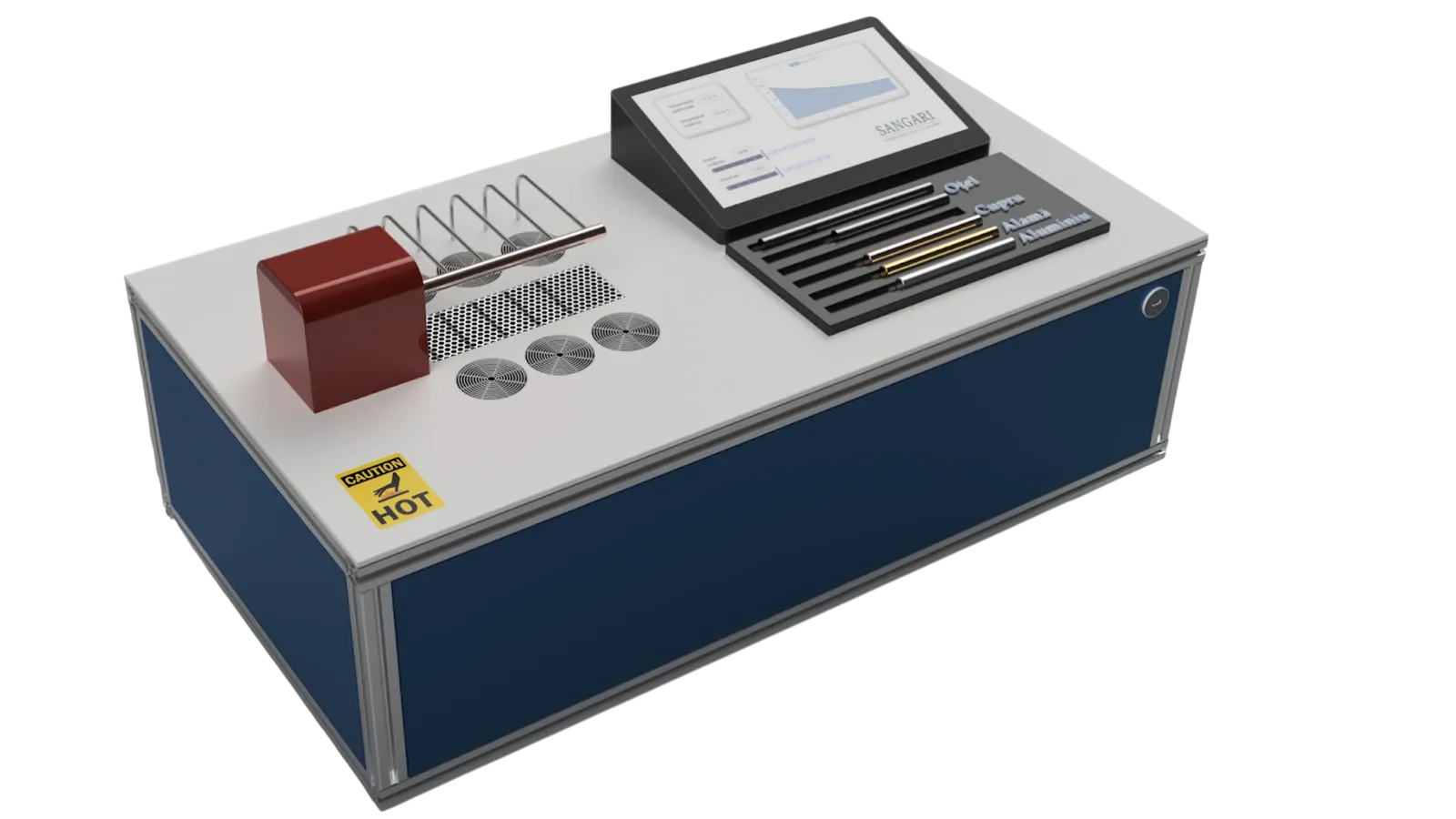
Experimental bench for the study of heat conduction and convection

TH322 — Heat conduction and convection bench
Overview

    Heat conduction and convection are two of the three fundamental mechanisms of heat transfer, and in practice they rarely act in isolation. The TH322 bench is designed to make these phenomena directly observable and quantifiable — giving students the tools to move from abstract theory to measured, reproducible data within a single laboratory session.

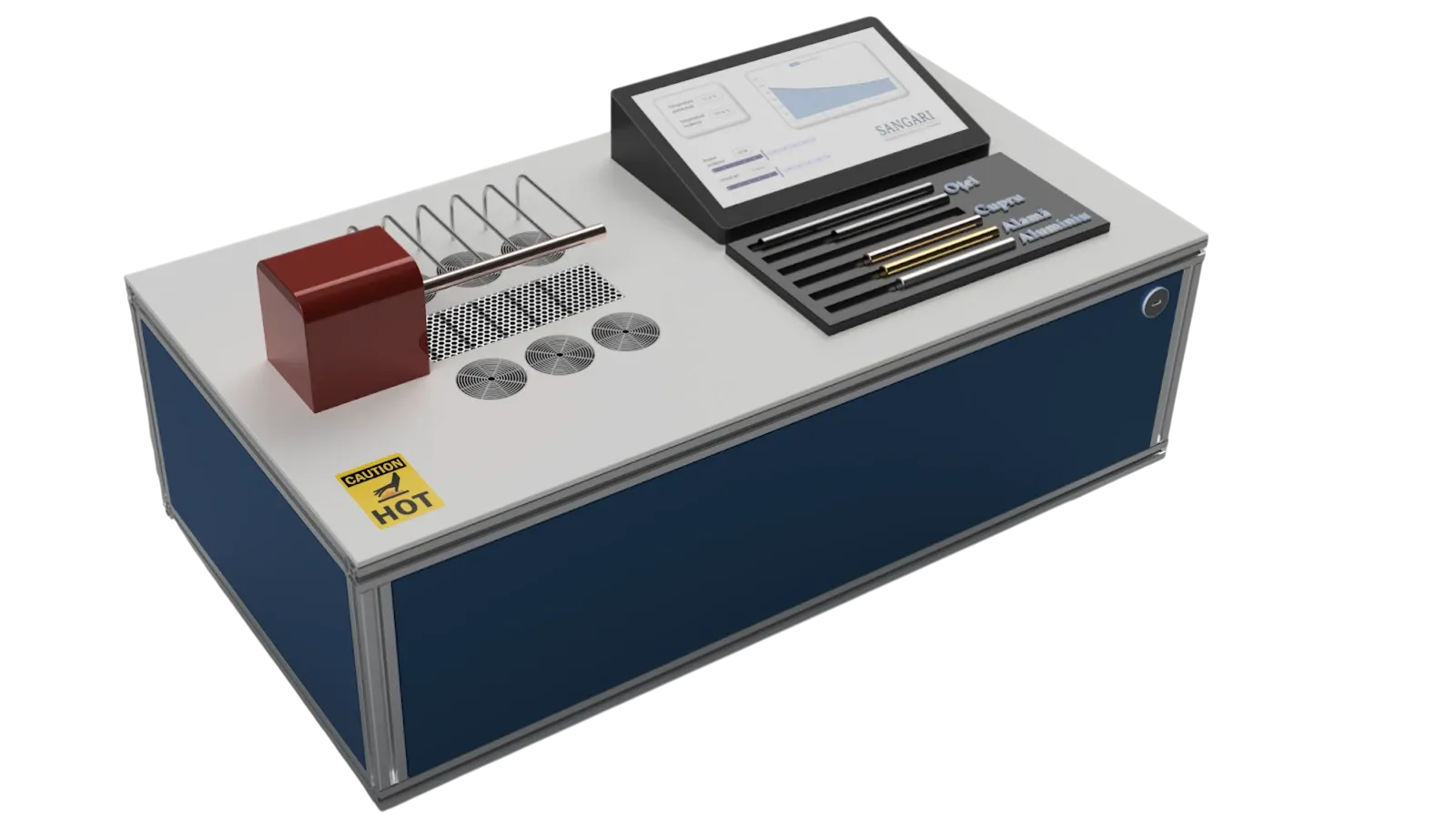
    The working principle is elegantly straightforward: a metal specimen is heated at one end and dissipates heat to the surrounding air along its length, behaving as a classic cooling fin — one of the most ubiquitous elements in engineering design. An array of six axial fans mounted below the specimen allows the instructor to switch seamlessly between free convection (still air) and forced convection (controlled airflow), while six temperature sensors capture the resulting thermal gradient in real time.
Key features
  • Unified study of heat conduction and convection in a single compact bench
  • Six included specimens — four short and two long — in copper, aluminium, brass, and steel
  • Six axial fans with continuously adjustable flow rate for controlled forced-convection conditions
  • Eight calibrated temperature sensors; heating power and air velocity displayed live in software
  • Microprocessor-based instrumentation fully integrated into the housing — no additional wiring required
  • USB connection to any Windows PC; unlimited observer workstations via LAN/WLAN with a single licence
  • Integrated Sangari Connected Learning e-learning platform with multimedia didactic materials
Laboratory experiments

    The following experiments are designed to build progressive understanding, from the fundamentals of Fourier's law through to practical heat-transfer coefficient calculations.

  • Fourier's law — material dependence of heat conduction.
      Comparing identical short specimens (104 mm, 32.6 cm²) in copper, aluminium, brass, and steel under identical heating conditions allows direct measurement of the thermal conductivity hierarchy among common engineering metals. Students observe how the temperature gradient steepens as conductivity decreases, providing a tangible verification of Fourier's law.
  • Effect of specimen length on heat dissipation.
      Replacing a short specimen (104 mm) with a long one (154 mm) of the same material — copper or steel — extends the heat-transfer area from 32.6 cm² to 48.4 cm². Students can quantify how fin length affects the total heat dissipated and explore the concept of fin efficiency, a critical parameter in the design of heat exchangers and electronic cooling systems.
  • Free convection — heat transfer in still air.
      With the fans switched off, the specimen dissipates heat entirely through natural convection and conduction. Students determine the convective heat transfer coefficient h from measured temperatures and heating power, and compare results with theoretical correlations for natural convection over flat surfaces.
  • Forced convection — effect of airflow velocity on heat transfer.
      Progressively increasing the fan speed (0-10 m/s measured air velocity) reveals the strong dependence of the convective coefficient on flow rate. Students construct an empirical h vs. v curve and fit it to the expected power-law relationship, gaining hands-on experience with the Nusselt-Reynolds framework before applying it in design exercises.
  • Free vs. forced convection — comparative analysis.
      Running the same specimen under identical heating power in still air and in forced flow makes the performance gain of forced convection immediately apparent in both the temperature readouts and the calculated heat transfer coefficients. This experiment is particularly effective at motivating the engineering trade-offs involved in cooling system design.
  • Temperature distribution along the fin — visualising the thermal gradient.
      With six sensors positioned along the specimen, the software plots the full axial temperature profile in real time. Students observe how the profile flattens under high-convection conditions and steepens when conductivity is low, directly linking the shape of the curve to the governing differential equation for extended surfaces.
  • Calculation of convective heat transfer coefficients.
      Energy balance on the specimen — using measured heater power, inlet and surface temperatures, and airflow velocity — enables students to compute h from first principles and validate it against standard empirical correlations. The exercise bridges the gap between textbook formulae and real experimental data.
Dedicated software
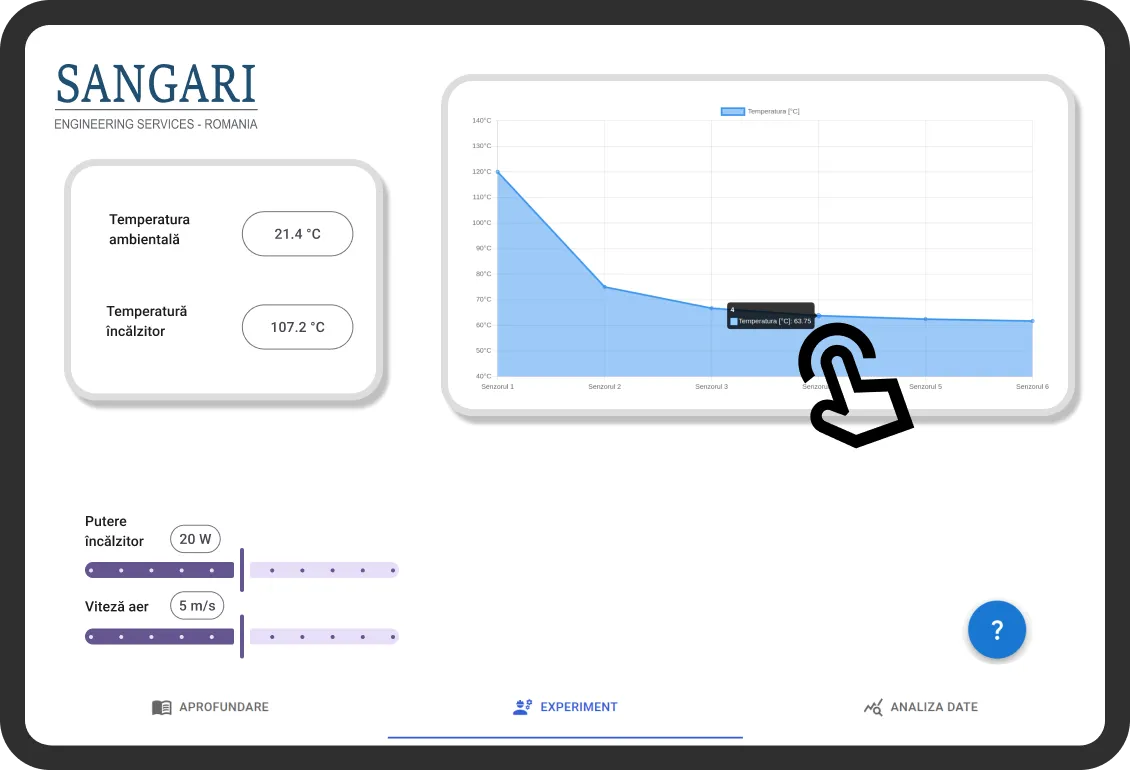
    TH322 software interface

    TH322 software interface

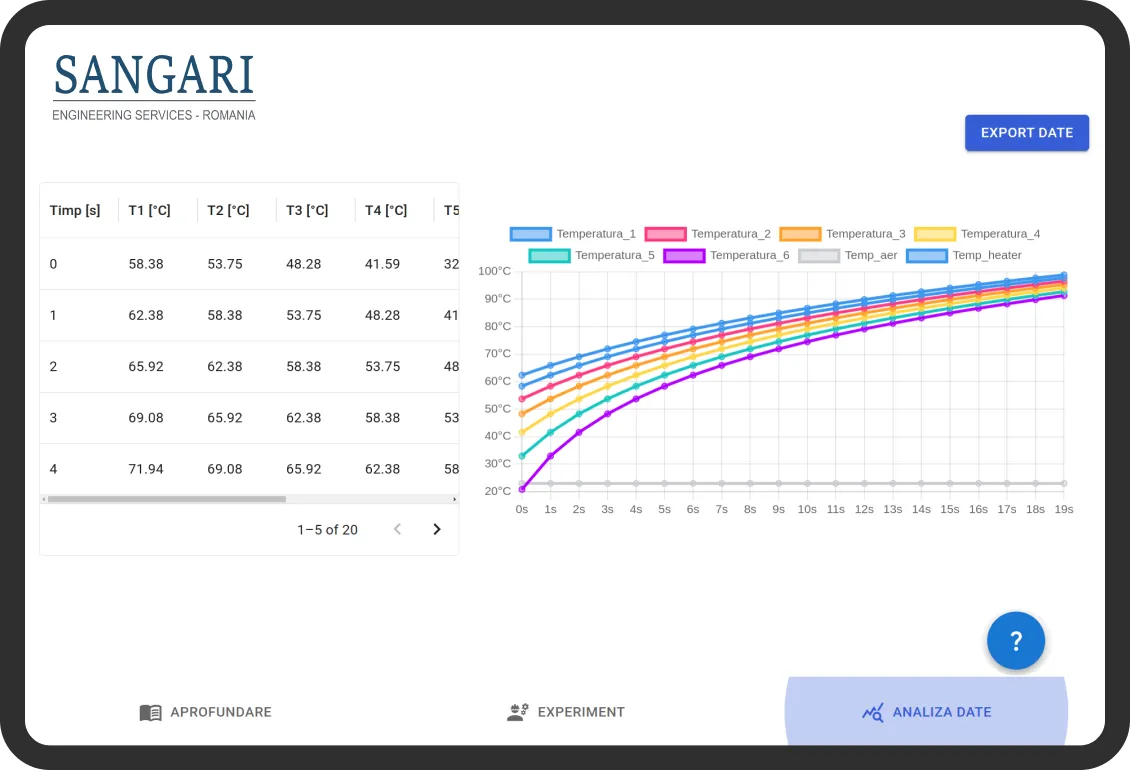
    TH322 data analysis

    TH322 data analysis

  • Real-time display of temperatures, heating power, and air velocity
  • Built-in data acquisition and export for post-session analysis
  • Educational software module with explanatory texts, illustrations, and guided exercises
  • Compatible with Windows 11; connects via USB
  • One software licence supports unlimited LAN/WLAN observer workstations simultaneously
E-learning platform
    Access to the Sangari Connected Learning platform — purpose-built to support modern, digitally-native learning environments. Students can review theory, work through interactive modules, and revisit experimental data at any time and from any device, freeing contact hours for discussion and deeper inquiry rather than passive instruction.
TH322 annotated diagram

TH322 annotated diagram

TH322 functional schematic

TH322 functional schematic

Heater
    Heating power 30 W
    Temperature limit 160 °C
Ventilators (×6)
    Max. flow rate 40 m³/h
    Nominal speed 14 400 min⁻¹
    Power consumption 7.9 W
Specimens — short (×4)
    Active length 104 mm
    Heat transfer area 32.6 cm²
    Materials Copper, aluminium, brass, steel
Specimens — long (×2)
    Active length 154 mm
    Heat transfer area 48.4 cm²
    Materials Copper, steel
Measuring ranges
    Air velocity 0 … 10 m/s
    Temperature 0 … 325 °C (×8 sensors)
    Heater power 0 … 30 W
Scope of delivery
  • Experimental bench
  • Full set of 6 specimens
  • Thermal paste
  • Dedicated software + USB cable
  • Set of instructional materials
220V
L 670 H 280 W 350 mm
17 kg

PIESE
DE
SCHIMB

15 ANI

Sangari

GARANȚIE

5 ANI

Sangari

Part of package

Fundamentals of Heat Transfer

Aquire a solid understanding of thermodynamics with this complete set of experimental equipment covering the core topics in heat transfer — conduction, convection, and radiation.

Request a quote for the full lab