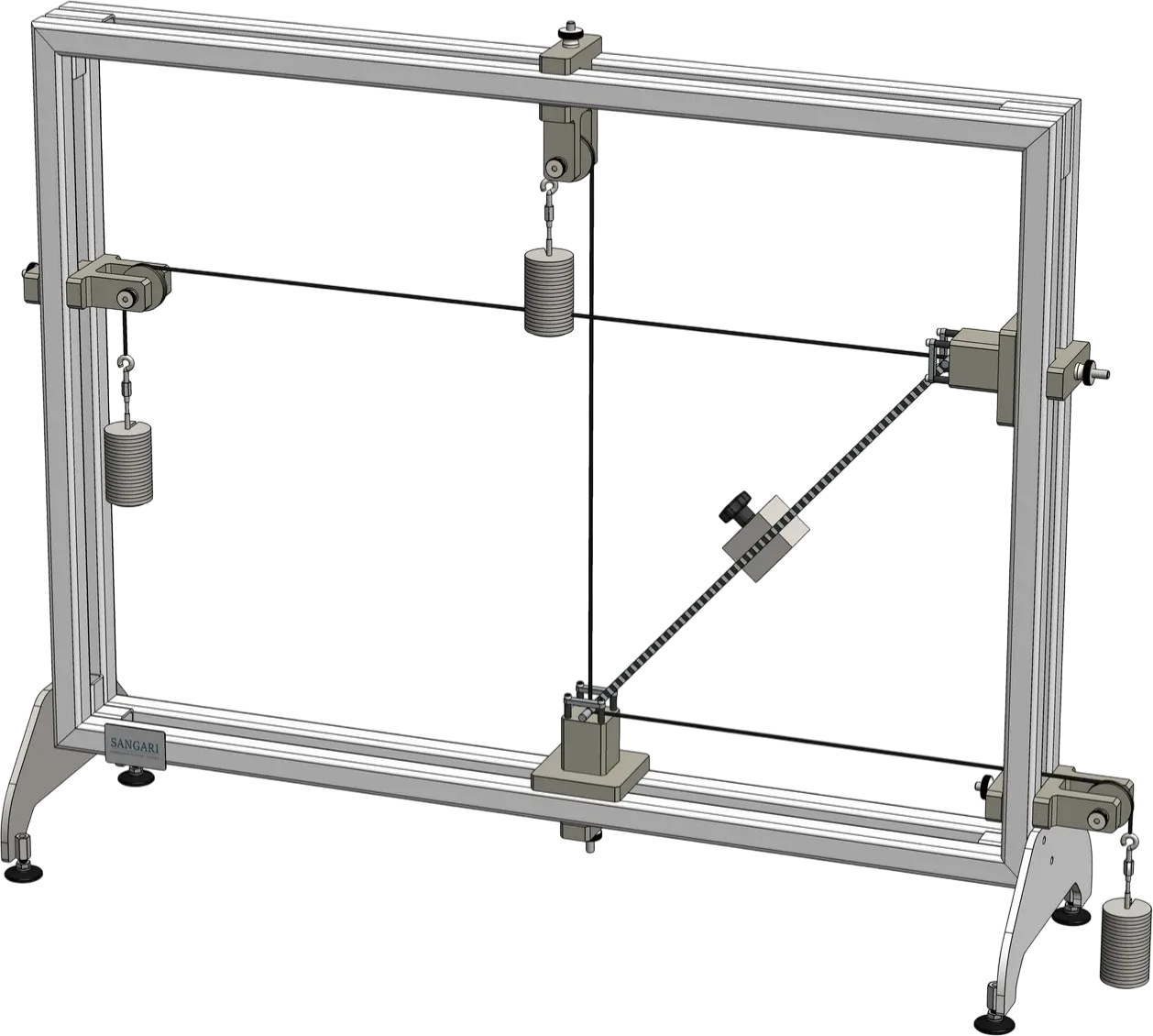
Experimental apparatus for the static equilibrium of a planar body with a fixed and a floating support
A model ladder resting between a fixed bottom support and a floating upper support, loaded by a sliding clamp weight at a position the student chooses, provides a physical illustration of the principle of freeing — the mental operation that converts supports into reaction forces on the free-body diagram. Cables with calibrated weights in the horizontal and vertical directions let the student replace the real support reactions with cable tensions and watch the ladder remain in equilibrium — a direct experimental confirmation of the two equilibrium conditions ΣF = 0 and ΣM = 0.
Experiments
Experimental development of the principle of "freeing" in statics
Calculation of the support reactions from the position of the clamp weight and the inclination angle
Application of the 1st and 2nd equilibrium conditions
Full compensation of the support reactions by cable forces in the horizontal and vertical directions
Distinction between fixed and floating bearings
Influence of the clamp-weight position on the support reactions
Influence of the inclination angle on the support reactions
Ladder model
Length650 mm
Self-weight2 N
Built-in rulegraduation 1 mm
Supports
Configuration1 fixed bearing + 1 floating bearing, both clamped to the mounting frame
Guide pulleys3 — redirect the cable weights into the x and y directions
Loading
Sliding clamp weight20 N, positioned with built-in rule
Cable weights3 × 1 N hangers · 12 × 1 N · 9 × 5 N
Measurement
Positionbuilt-in rule (1 mm); tape measure 3000 mm (1 mm)
A complete set of experimental modules covering the core topics in strength of materials — elastic line, torsion, Euler buckling, frame deformation, plastic bending, and static equilibrium.