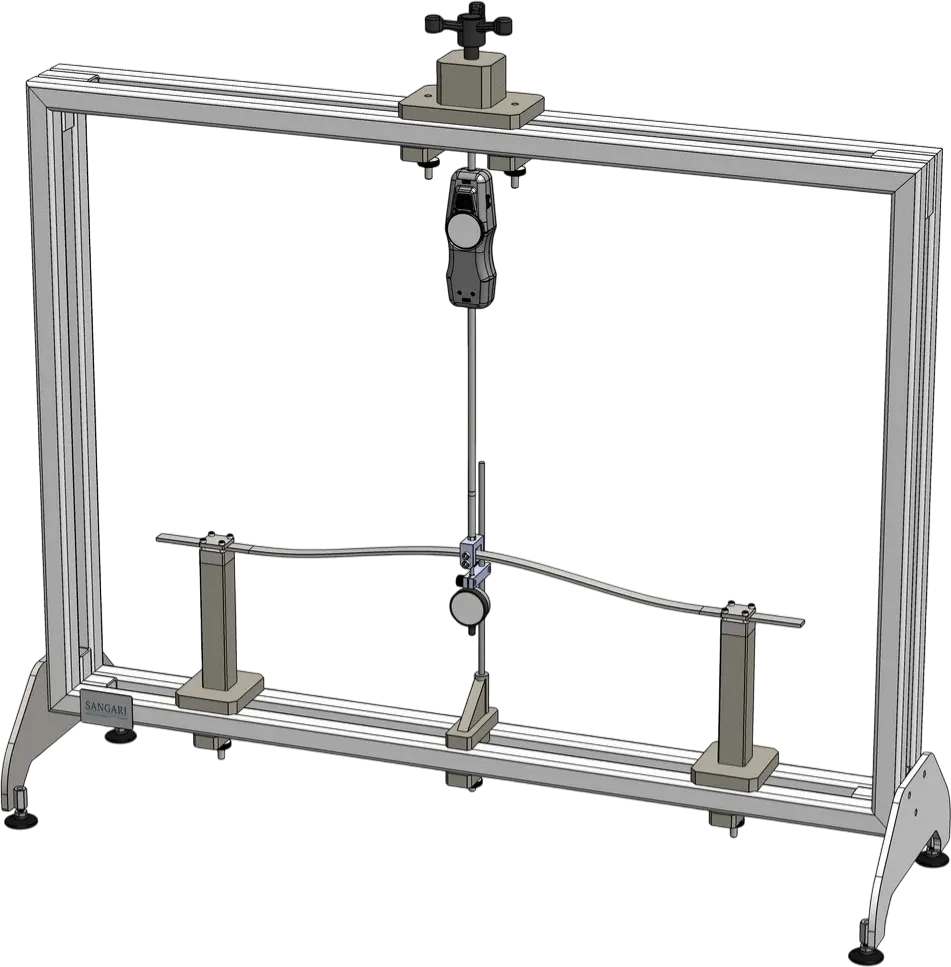
Experimental apparatus for the elastic-to-plastic bending of beams and the formation of plastic hinges
A beam mounted on a fixed-and-floating support pair is loaded, at a chosen position, by a high-force loading screw that drives it continuously from the elastic range into permanent plastic deformation. A dial gauge records the deflection while the load increases; unloading then reveals the residual deformation. The resulting load–extension curves make the three regimes — linear elastic, nonlinear transition, plastic flow — directly observable, and allow the student to confirm that the superposition principle, which holds in the elastic range, fails once yielding begins.
Experiments
Loading of a beam with a point load from the elastic range into plastic deformation
Plot of the load–deflection diagram, with elastic, transition and plastic regions
Comparison of the loading and unloading curves; residual (permanent) deflection
Demonstration of the invalidity of the superposition principle in the plastic region
Formation of plastic hinges under the applied load
Influence of cross-section (rectangular vs. H-profile) and material (steel vs. aluminium)
Plastic collapse of indeterminate beams (propped cantilever, encastre)
Beams
Steel beam1 × 1000 × 15 × 3 mm
Aluminium beam1 × 1000 × 15 × 3 mm
Aluminium H-profile1 × 1000 × 15 × 15 × 2 mm
Supports
Bearings1 fixed + 1 floating (re-configurable to simply-supported, propped-cantilever, encastre)
Loading & measurement
Load applicationthreaded-spindle loader, max. ±5000 N, travel 100 mm
A complete set of experimental modules covering the core topics in strength of materials — elastic line, torsion, Euler buckling, frame deformation, plastic bending, and static equilibrium.