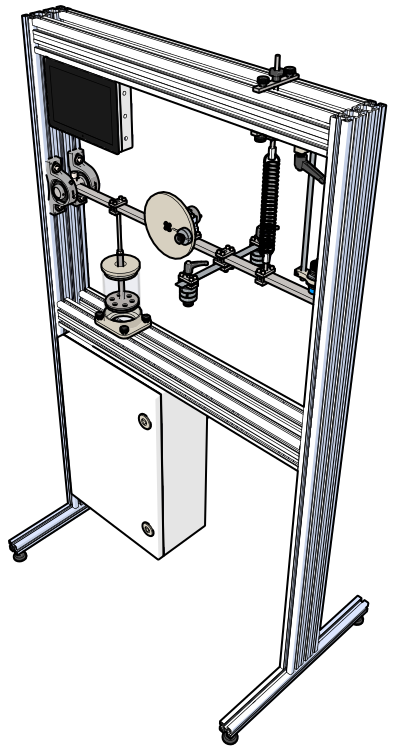
Experimental apparatus for the study of free and forced vibrations, resonance and damping
Laboratory experiments
Spring stiffness measurement.
Free vibration — natural frequency and the effect of mass.
Free vibration — effect of spring stiffness.
Damped free vibration — logarithmic decrement and damping ratio.
Forced vibration — amplitude response and resonance.
Phase response — phase lag between excitation force and beam displacement.
Vibration absorber — inactive and active, and tuning.
Effect of excitation amplitude — imbalance mass variation.
Key features
Pivoting steel beam on a rigid aluminium profile frame — all experimental setups use the same beam, minimising changeover time
Four interchangeable helical springs (0.75, 1.5, 2.5 and 3.0 N/mm) for systematic study of the effect of stiffness on natural frequency
Motor exciter with integral imbalanced masses, driven by a variable-speed controller (0-50 Hz); digital tachometer displays excitation frequency
Adjustable oil dashpot with damping disc — damping coefficient varied continuously without disassembly
Tunable vibration absorber (secondary leaf-spring and mass assembly) demonstrates 2-DoF absorber effect and anti-resonance
Non-contact beam displacement sensor — no friction, no added mass on the oscillating system
Integrated data acquisition interface (USB) with supplied software for real-time waveform display, frequency analysis, and damping coefficient measurement
Set of calibrated masses for systematic variation of the vibrating mass
Frame and beam
FrameRigid aluminium profile, free-standing
Frame dimensions1 400 mm (L) × 500 mm (W) × 1 500 mm (H)